Mercedes-Benz C-Class · Grand update guide
How the gas C-Class borrows from Mercedes’ EVs
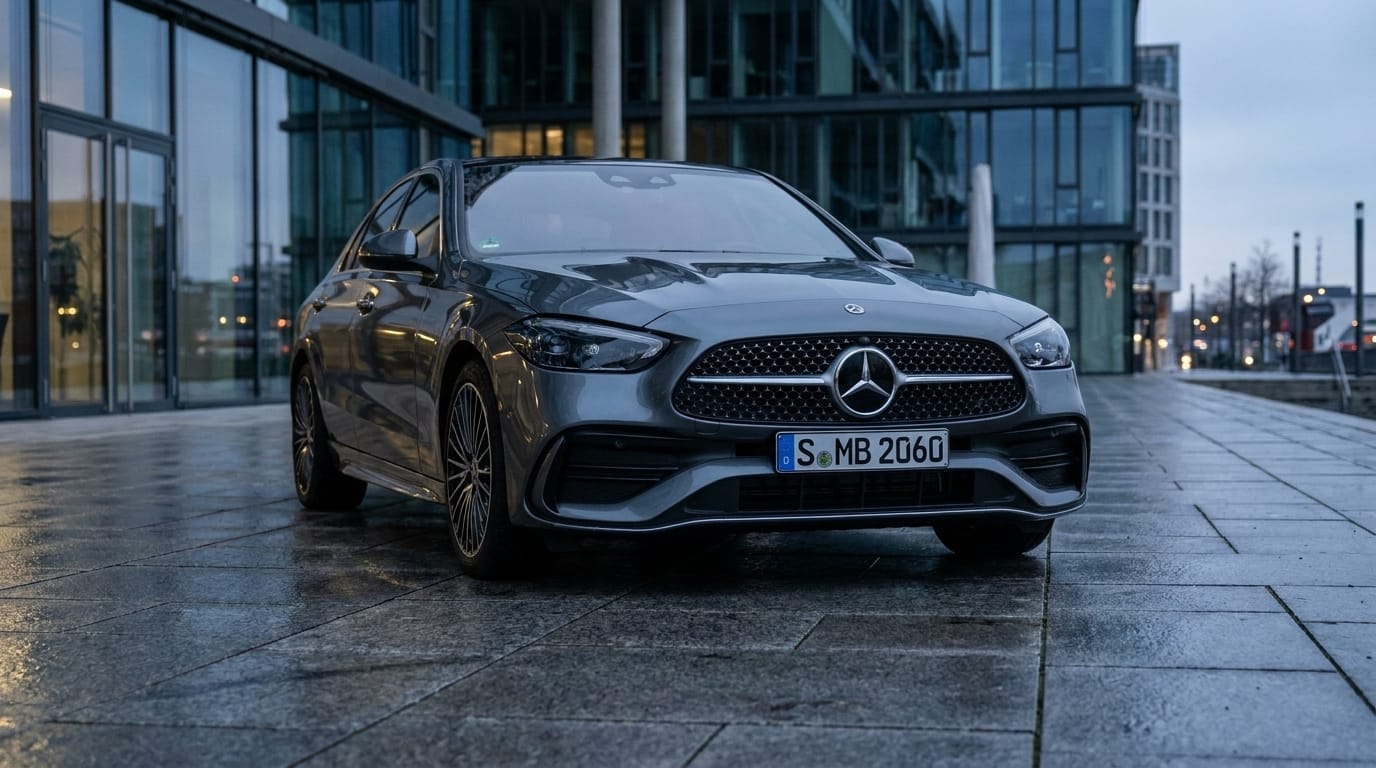
The luminous grille does the shouting. The consequential work sits behind it: Mercedes has moved its MB.OS software architecture, artificial-intelligence assistant and broader update capability into the familiar combustion C-Class, while retaining its basic vehicle architecture and recognisable cabin layout.
Matched changes
Our feature-by-feature check finds a layered facelift: four design changes make the family resemblance visible, four cabin and software changes alter how you use the car, and four engineering changes revise how it drives and charges.
The short version
A familiar car, now plugged into a newer Mercedes
The refreshed Saloon and Estate remain combustion-engine C-Classes rather than converted electric cars. CarWale reports that the basic architecture of the current generation is retained, and the dashboard keeps its existing 12.3-inch digital instrument display and 11.9-inch portrait central screen. That continuity matters: this is not a ground-up replacement.
Yet calling it only a cosmetic facelift misses the useful bit. Mercedes-Benz says MB.OS now manages all vehicle domains and enables over-the-air updates for numerous functions. In plain English, the operating-system layer can update connected parts of the car after purchase instead of limiting change to the infotainment screen. Mercedes also revises the electrified engines, suspension, assistance hardware and plug-in-hybrid charging.
Before / after
Find each change
Choose a group to narrow the list. Without JavaScript, all 12 comparisons remain visible.
12 features shown
Radiator grille
EV-derived design- Outgoing treatment
- A conventional, unlit grille face.
- Refreshed treatment
- A larger grille with chrome star pattern, contour lighting and, depending on market, an illuminated central star.
Status: contour lighting confirmed; central-star illumination varies by market.Mercedes-Benz; Autocar India
Headlamp signature
Shared model-line cue- Outgoing treatment
- Conventional C-Class daytime-running-light graphics.
- Refreshed treatment
- Reshaped lamps with three-pointed-star daytime-running-light signatures.
Status: standard visual signature reported for the refreshed range.Mercedes-Benz; Hypebeast; Autocar India
Rear light graphics
Shared model-line cue- Outgoing treatment
- The previous tail-lamp graphic.
- Refreshed treatment
- Three-pointed-star signatures in the Saloon tail-lamps.
Status: Autocar India says the Estate does not receive this star graphic.Autocar India
Front bodywork
Shared model-line cue- Outgoing treatment
- The original fifth-generation bumper and separate lamp-and-grille treatment.
- Refreshed treatment
- A redesigned front apron, more enclosed intakes and a dark visual link between lamps and grille.
Status: exterior redesign; the underlying architecture remains familiar.Mercedes-Benz; Autocar India; CarWale
Cabin screen layout
ICE-specific continuity- Outgoing treatment
- A separate driver display and portrait central touchscreen.
- Refreshed treatment
- The same basic arrangement is retained rather than adopting the electric model’s broad passenger-screen treatment.
Specification: 12.3-inch instrument display; 11.9-inch central display.Mercedes-Benz; Carscoops; CarWale
Operating system
EV-derived technology- Outgoing treatment
- The earlier MBUX software generation.
- Refreshed treatment
- MB.OS manages the vehicle’s domains and supports over-the-air updates for numerous functions.
Status: software and update capability confirmed by Mercedes-Benz.Mercedes-Benz
Voice assistant
Shared model-line technology- Outgoing treatment
- The earlier MBUX voice assistant.
- Refreshed treatment
- An AI-assisted system designed for multi-turn conversation and contextual memory.
Status: Mercedes names ChatGPT, Microsoft Bing and Google Gemini integrations in the latest interface.Mercedes-Benz; Carscoops; CarWale
Steering-wheel controls
Shared model-line interface- Outgoing treatment
- Touch-sensitive steering-wheel controls.
- Refreshed treatment
- More conventional physical controls return, including a volume roller.
Status: tactile interface change reported independently.Hypebeast; CarWale
Petrol engine assistance
ICE-specific- Outgoing treatment
- Electrified combustion engines already used 48-volt mild-hybrid assistance.
- Refreshed treatment
- The M254 Evo 2.0-litre turbo four gains a second-generation integrated starter-generator and an electric auxiliary compressor.
Specification: up to 23 hp and 205 Nm of brief electric assistance; European petrol outputs reported at 177, 218 and 258 hp.Mercedes-Benz; Autocar India
Plug-in hybrid
EV-derived technology- Outgoing treatment
- A plug-in-hybrid option within the combustion range.
- Refreshed treatment
- Revised C 300 e and C 400 e versions combine the updated petrol engine with a larger usable battery specification and faster charging.
Specification: 19.53 kWh usable battery; up to 100 km electric range [WLTP]; up to 11 kW AC and 55 kW DC charging.Mercedes-Benz; Carscoops; Autocar India
Chassis tuning
ICE-specific- Outgoing treatment
- The existing W206 suspension tune.
- Refreshed treatment
- Retuned suspension, revised damping and additional sound insulation.
Status: Mercedes claims greater agility while preserving long-distance comfort; no independent instrumented test is yet provided here.Mercedes-Benz; Carscoops; Autocar India
Rear-axle steering
Shared model-line hardware- Outgoing treatment
- No equivalent option cited in the supplied outgoing-model material.
- Refreshed treatment
- Optional rear wheels steer opposite the fronts at low speed and with them at higher speed.
Specification: up to 2.5 degrees; Mercedes says the turning circle falls by 43 cm to 10.64 m.Mercedes-Benz; Carscoops; Autocar India
How the transfer works
EV influence arrives by three different routes
One · The face
Design language moves faster than platforms
The glowing perimeter, repeated stars and connected lamp-and-grille graphic make the combustion car read as part of Mercedes’ newer electric family. It is visual kinship, not proof of shared propulsion hardware. Underneath, CarWale says the current-generation architecture remains.
Two · The software
MB.OS changes the ownership cycle
An operating system is the coordinating software layer, not merely the screen graphics. Mercedes says MB.OS manages the car’s domains and can deliver over-the-air updates to numerous functions. That is the deeper transfer: a combustion model joins a software-led product cycle associated with the company’s newest vehicles.
Three · Electric assistance
Combustion remains, electricity does more work
The mild hybrid’s integrated starter-generator assists the engine briefly, while the plug-in hybrid can cover a claimed maximum of 100 km electrically under the WLTP laboratory cycle. Neither makes the C-Class a battery-electric car; both increase the electrical system’s role.
The boundary
What did not migrate
The cabin retains its two-screen arrangement, and the car remains available with petrol and diesel engines. The update borrows the electric range’s look and digital logic without erasing the distinction between powertrains.
“The new C‑Class proves that continuity and innovation are not mutually exclusive.”Mathias Geisen, Mercedes-Benz board member for Sales & Customer Experience, in the company’s 17 August 2026 release
People and interests
Who wants what from this update
Mercedes-Benz
The company wants the combustion C-Class to remain visually and digitally current beside the newly launched electric version. It calls this the most comprehensive technical upgrade in C-Class history and began German ordering on 18 August 2026.
Existing C-Class drivers
The offer is deliberately conservative and modern at once: familiar proportions and screen placement, but physical steering-wheel controls, newer software and revised electrified engines. That is less dramatic than a new platform—and probably the point.
Regulators and assessors
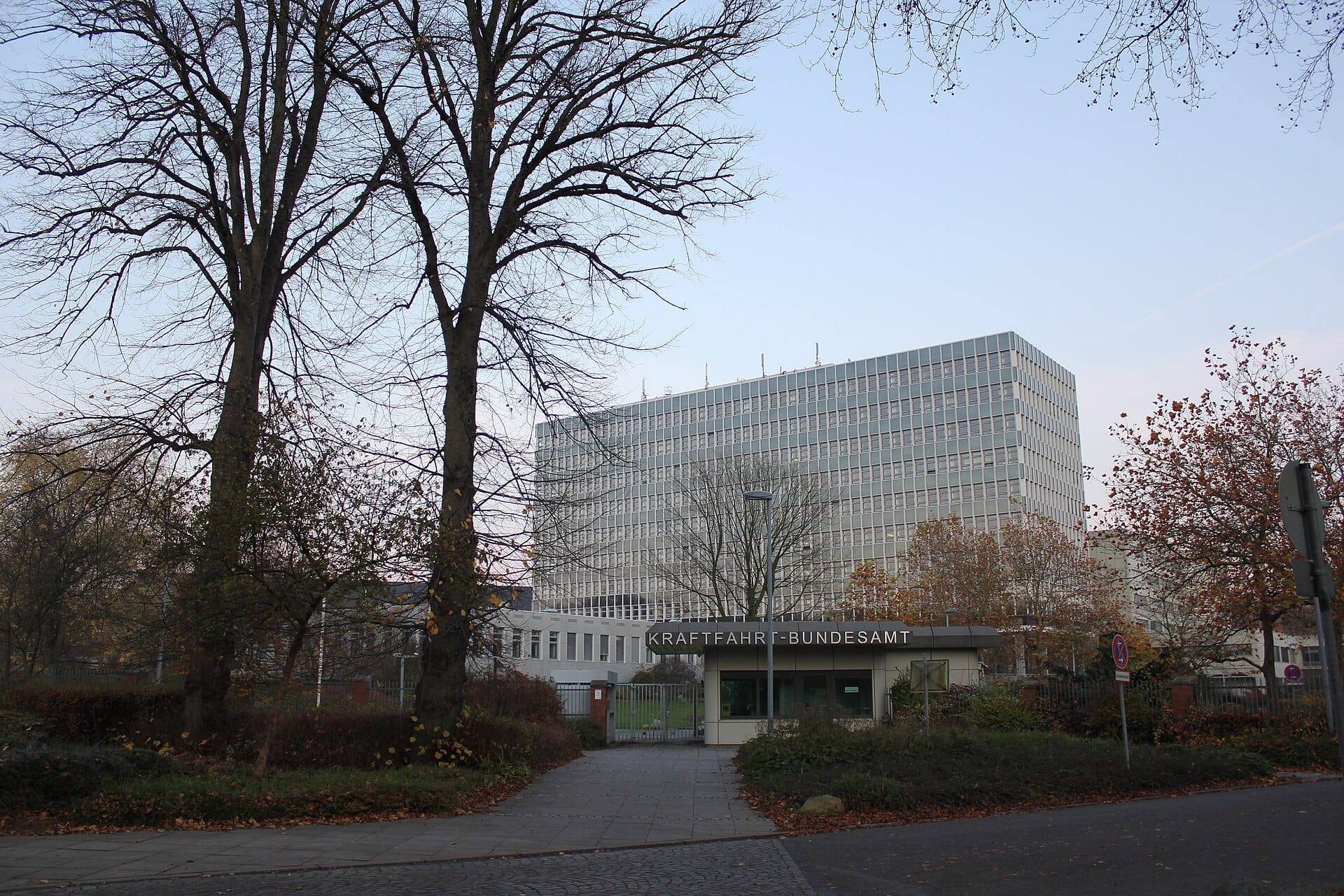
Kraftfahrt-Bundesamt, Germany’s federal motor transport authority, handles type approvals, recalls and registration statistics. Euro NCAP independently evaluates safety. Neither body’s record supplied here constitutes an instrumented verdict on this newly refreshed specification.
The rival in the room
The BMW 3 Series remains a natural segment reference, but this is not a rival road test. The relevant observation is narrower: Mercedes is using software and electrified powertrains to renew its combustion saloon while preserving the C-Class identity.
The counter-reading
Is this mostly a light show?
There is a strong case for saying yes—at first glance. The most visible work is concentrated on the nose, the dashboard layout stays familiar and the current basic architecture remains. Star lamps and an illuminated grille can make a conventional mid-cycle facelift look more radical than it is.
But that reading stops at the bodywork. The source record also contains MB.OS, wider over-the-air updating, an AI-assisted interface, revised mild-hybrid hardware, updated plug-in-hybrid charging, retuned suspension and optional rear steering. Those changes do not turn it into a new-generation car. They do make “merely cosmetic” too neat a verdict.
A useful line in the sand
Announcement is not measurement
Mercedes’ specifications tell us what has changed on paper. They do not yet tell us how the revised chassis feels, how reliably the assistant works on the road or whether the claimed electric range is reproduced in independent testing. KBA registration publications can later show market uptake in Germany, but they cannot answer those driving questions.
Still unresolved
What we need to learn next
- Which powertrains, rear-steering option and plug-in-hybrid charging features will reach each market.
- Whether independent testing confirms Mercedes’ claims for agility, refinement and real-world electric range.
- How broad the over-the-air update scope proves to be after cars enter customer service.
- What the final United States pricing and equipment structure will be; Carscoops reports arrival there in the first half of 2027.
Source notes
Read the underlying material
- Mercedes-Benz: “The new Mercedes-Benz C-Class: Refined strength. Trusted continuity.”, 17 August 2026.
- Carscoops: “Mercedes Gives The Gas C-Class A Bigger Overhaul Than Its New Grille Lets On”, 17 August 2026.
- Autocar India: “Mercedes C-Class facelift debuts with upgraded engines, more features”, 18 August 2026.
- CarWale: “2027 Mercedes-Benz C-Class Revealed: What’s New?”, 18 August 2026.
- Hypebeast: “Mercedes-Benz’s C-Class Gets an EV-Inspired Facelift for 2027”, 19 August 2026.
Transparency: This guide is based on Mercedes-Benz’s product release and specifications, checked against reporting from Carscoops, Autocar India, CarWale and Hypebeast. Manufacturer claims are identified as such; no independent instrumented test of the refreshed car was supplied. The lead image is explicitly labelled as an AI-generated stand-in.