tisdag 15 sep
Allt om motor

New technology · 26 August 2026

Inside the Army’s autonomous Ford F-250 drone defence test

On 18 August, the U.S. Army tested a semi-autonomous Ford F-250 carrying Forterra’s driving system and an Edda counter-drone turret. The pickup came from Ford; the autonomous fighting system did not.

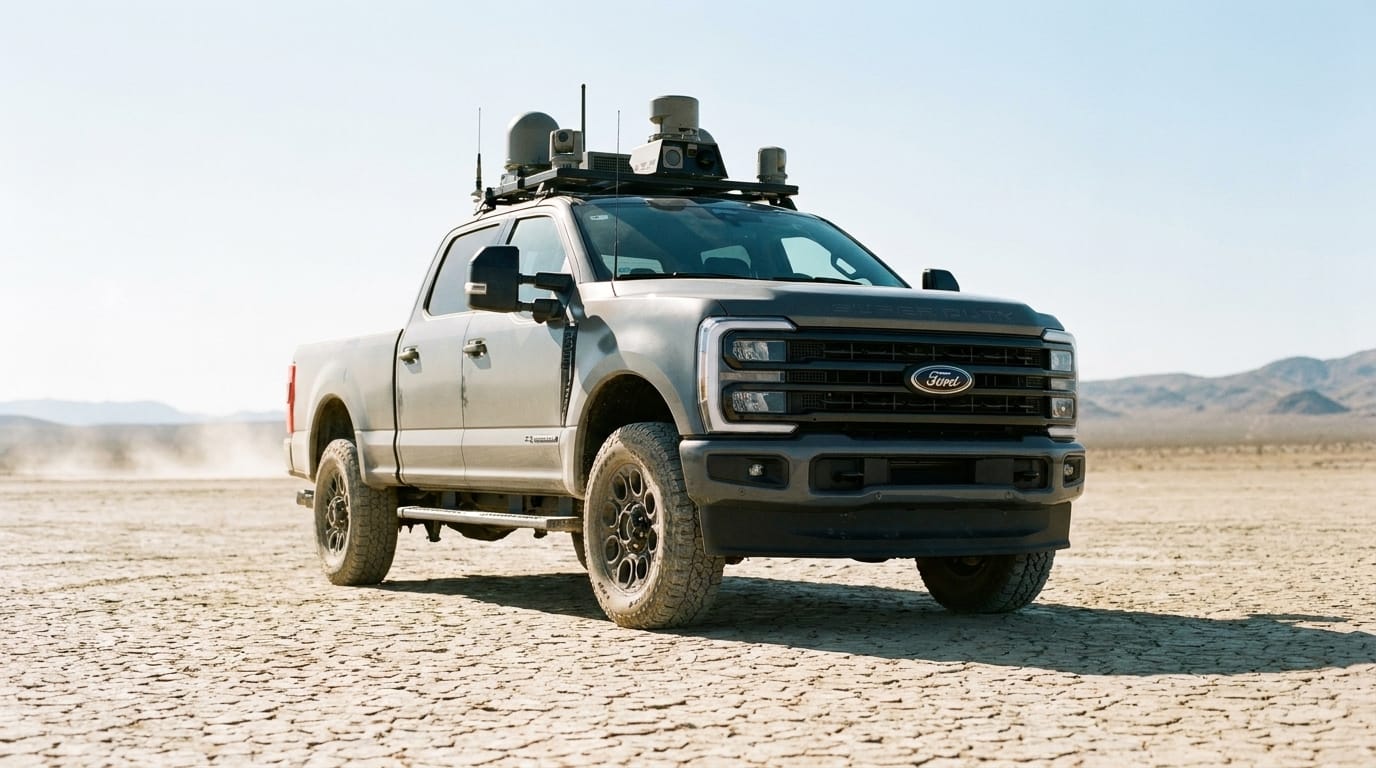
A grey Ford F-250 truck with roof-mounted tactical sensors parked on a cracked desert dry lake bed.
An autonomous Ford F-250 equipped with roof-mounted sensors scans the horizon over a desert dry lake.Illustration: AI-genererad

The machine in four figures

A work truck underneath, a layered defence system above

The numbers describe two different things. The large capacities belong to the standard 2026 F-250 platform; the smaller figures describe the Edda turret fitted to the Army test vehicle. They are useful for scale, not a consumer comparison.

Maximum towing capacity
23,000 lb
Jones Ford Verde Valley states this maximum for the 2026 Ford F-250.
Maximum payload
4,246 lb
According to Jones Ford Verde Valley, for the 2026 Ford F-250.
Edda turret weight
23 kg
50 pounds, according to @Drone_Wars_.
Maximum stated range
100 m
328 feet; the stated engagement range is 10–100 metres, according to @Drone_Wars_.

Who supplied what

Ford supplied the underlying commercial truck platform. Forterra says it delivers the integrated autonomous mission systems on F-250 vehicles under the Sandhills 2.0 contract. 9 Mothers supplied the Edda counter-drone turret. The XVIII Airborne Corps led the Army experimentation.

Road & Track reports, citing Ford spokesperson Richard Binhammer, that Ford was not directly involved in upfitting this Sandhills vehicle. The outlet separately reports a Ford defence contract for three Super Duty prototypes for Heavy Infantry Squad Vehicle evaluation; that is not the same programme.

From commercial platform to live fire

One test, followed through the organisations that built it

The chronology keeps the claims beside the voices making them. Use the filters to isolate the vehicle, the turret or the Army’s test; without JavaScript, every entry remains visible.

The ordinary hardware sets the starting point

According to Jones Ford Verde Valley, the 2026 F-250 has a maximum payload of 4,246 pounds, while the dealer states a maximum towing capacity of 23,000 pounds. Those limits describe the commercial truck before autonomy hardware and counter-drone equipment are added.

Source: Ford Super Duty Truck Towing Capacity & Payload Specs Guide [2026]
Forterra names itself as the integrator

“Under the Sandhills 2.0 contract, Forterra is delivering fully integrated autonomous mission systems on Ford F-250 vehicles for the US Army”

Forterra, company statement

This is the pivotal procurement distinction: the recognisable Ford body is the host platform, while Forterra identifies itself as the contractor delivering the integrated mission system.

The combined vehicle reaches Range 63

According to Motor1, the U.S. Army tested a semi-autonomous Ford F-250 with Forterra’s AutoDrive system and an Edda turret during the Project Sandhills 2.0 live-fire exercise at Range 63, Fort Bragg.

“A Forterra AutoDrive-equipped Ford F-250 semi-autonomous vehicle fitted with an Edda counter-unmanned aircraft system turret supports the Project Sandhills 2.0 live-fire exercise at Range 63, Fort Bragg, N.C., Aug. 18, 2026.”

DVIDS, Sandhills Project image record
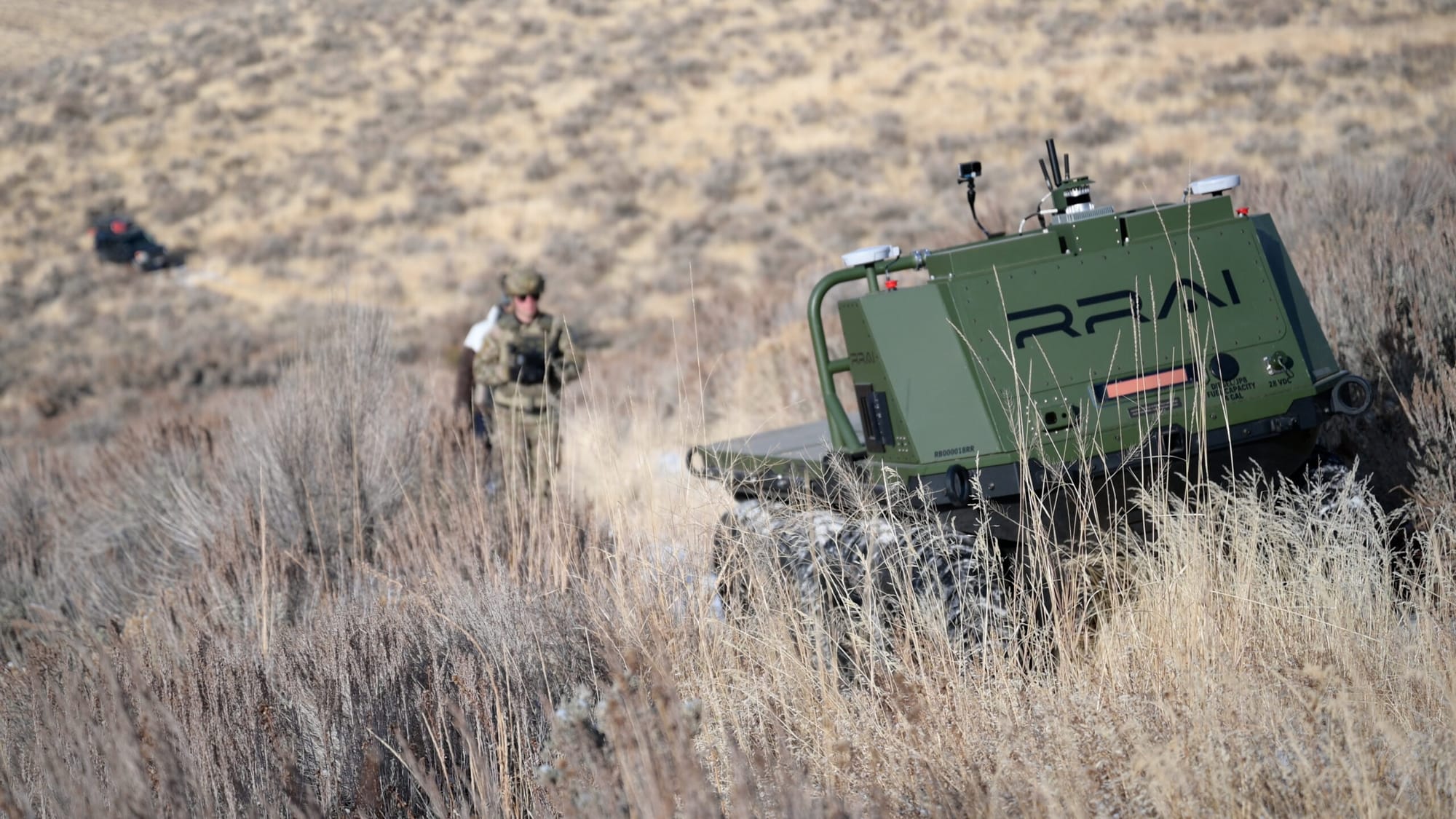
An olive green unmanned military ground vehicle with RRAI branding traversing dry grassy hills while soldiers follow behind.
Forterra’s wider field of work is autonomous ground movement alongside soldiers; this image shows a different unmanned military ground vehicle in that context. Foto: www.forterra.com

Detection begins with sound

@Drone_Wars_ reports that the 23-kilogram Edda turret was designed for fast-moving drones around 7 inches, or 18 centimetres, across a stated range of 10–100 metres. The account says acoustic sensors first detect an approaching drone, after which optical tracking locks on and a shotgun effector engages.

ListenPassive acoustic sensors detect an incoming drone.
TrackAn onboard optical system locks onto the target.
EngageThe shotgun effector acts within the stated range.

These mechanism and range details are reported by @Drone_Wars_; no independent instrumented measurement is supplied in the evidence.

The point-defence turret hits a drone

“A Bumblebee V2 small unmanned aircraft system falls after an EDDA point-defense turret engages it during Project Sandhills 2.0 counter-unmanned aircraft testing at Range 63, Fort Bragg, North Carolina, on August 18, 2026.”

DVIDS, counter-UAS engagement image record

The official record documents an engagement and a falling target. It does not, by itself, establish how the system would perform outside this test.

Experimentation is the procurement method

“Through experimentation, the XVIII Airborne Corps is changing how we innovate and fight. We are putting emerging tech into the hands of Soldiers and partnering directly with industry, immediate warfighter feedback rapidly refines autonomous capabilities in real time.”

@18airbornecorps, official account

The language matters: this was operational experimentation intended to produce feedback, not evidence that the configuration had entered broad service.

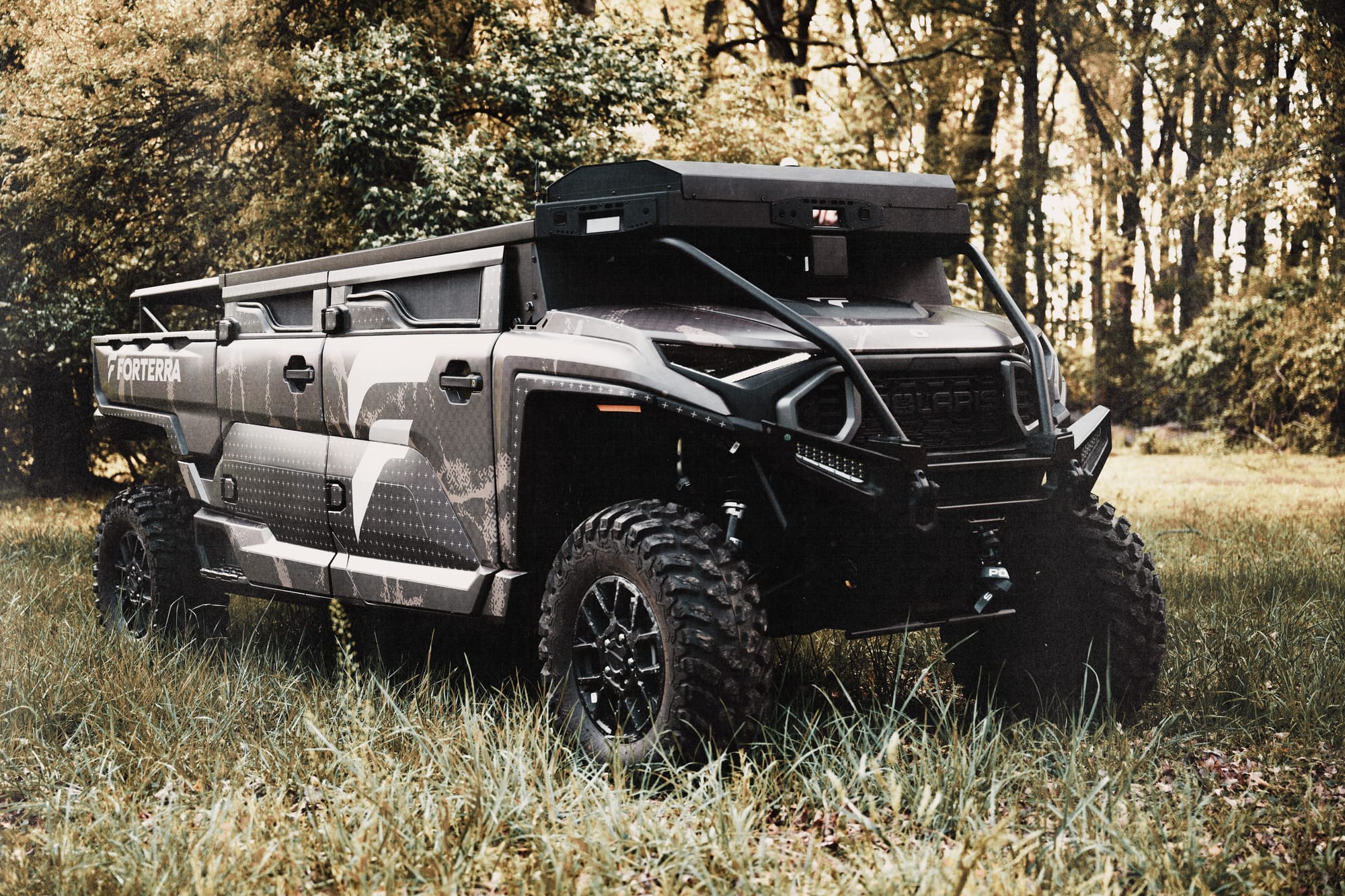
A rugged tactical off-road vehicle with Forterra branding parked in a grassy field near a forest.
A Forterra-branded tactical vehicle. It illustrates the contractor’s autonomous-ground-vehicle work, not the F-250 used at Sandhills. Foto: www.forterra.com

A person is meant to remain in the loop

@Drone_Wars_ quotes Col. Jeff Burgess as saying: “We want to ensure that a human remains in the control loop” before lethal action. Because the supplied evidence is a second-hand account, that safeguard should be read as the Army’s stated intention rather than an independently verified operating rule.

The available record therefore supports a narrow conclusion: a semi-autonomous truck and turret combination was exercised successfully against a small drone target on this range, while the precise approval chain for lethal action remains described through reported statements.

What this changes: commercial vehicles can shorten the path from available chassis to military experiment, but their familiar badges can obscure who performs the consequential integration. Here, Forterra supplied the autonomous mission system, 9 Mothers supplied the turret, and the Army evaluated the result. Ford built the base truck.

Transparency: This account is based on DVIDS records, statements from Forterra and the XVIII Airborne Corps, specialist reporting supplied with the story, and published vehicle specifications. The lead image is AI-generated and labelled as an illustration; inline Forterra images are credited press material.